Operationalising Zero Trust Architecture: Engineering Lessons, Workload Identity, and the 2026 NSA Guidelines
2026-05-29
 The Secure Velocity Report
Modernisation, Migration, and the CISSP Edge.
The Secure Velocity Report
Modernisation, Migration, and the CISSP Edge.
Operationalising Zero Trust Architecture: Engineering Lessons, Workload Identity, and the 2026 NSA Guidelines
The modern enterprise security perimeter has collapsed. The rapid adoption of hybrid cloud models, decentralised workforces, and autonomous machine workloads has dismantled the traditional castle-and-moat security design. Historically, corporate security structures operated on an implicit trust model: traffic originating inside the local area network was presumed benign, while external traffic was treated with suspicion. Today, sophisticated cyber adversaries routinely exploit this internal trust, proving that network location is an entirely inadequate proxy for security.
Zero Trust Architecture (ZTA) addresses these structural vulnerabilities by moving enforcement away from static, broad network perimeters and shifting focus directly to individual users, devices, and resources. By treating every access attempt as an explicit security boundary, ZTA establishes a resilient, defendable posture. Implementing this model requires a deep engineering understanding of policy-driven access, comprehensive environment discovery, cryptographic workload identification, and the decommission of legacy access systems.
Technical Foundations of the Zero Trust Control Plane
At its core, a zero trust model operates on a simple guiding directive: never trust, always verify. This framework is built upon three non-negotiable architectural tenets:
- Assume Breach: Security teams must design systems under the assumption that attackers are already operating within the internal environment. This mindset mandates the end-to-end encryption of all communications, the elimination of broad network perimeters, and the continuous scrutiny of internal data flows.
- Least-Privilege Access: Access permissions must be highly scoped, granting both human and machine identities only the minimal level of authority necessary to complete a specific task. This requires replacing permanent, standing privileges with time-bound, just-in-time (JIT) access mechanisms.
- Continuous Verification: Trust must be treated as a highly transient state. Security controls must continuously validate the requesting identity, device compliance, and behavioral telemetry throughout the entire duration of an active session.
To implement these tenets, organizations must decouple the control plane from the data plane, adhering to the logical design codified in the NIST SP 800-207 guidelines.
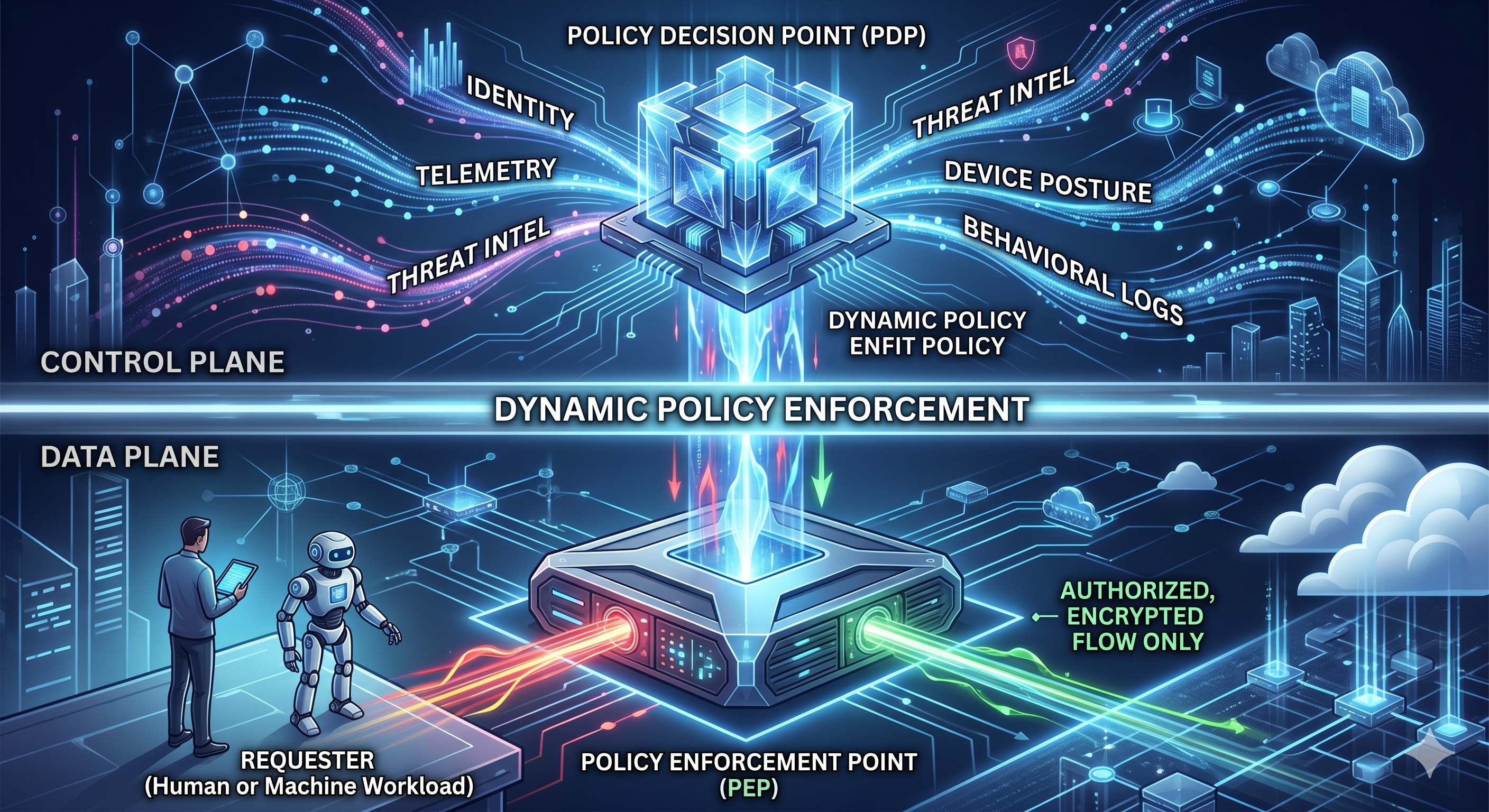
The Policy Decision Point (PDP) acts as the centralized brain of the ZTA control plane. The PDP is responsible for evaluating access requests against corporate security policies, ingesting real-time signals from identity providers, endpoint detection platforms, and threat intelligence feeds to make access determinations.
The Policy Enforcement Point (PEP) serves as the gatekeeper, situated directly in the path of the data flow near the protected resource. The PEP handles the direct execution of PDP decisions. By enforcing access controls at the resource boundary—via gateways, identity-aware proxies, or session-monitoring sidecars—the PEP ensures that unauthorized traffic is rejected before it can reach sensitive databases or application servers.
Operationalising the 2026 NSA Zero Trust Implementation Guidelines
A common failure mode in modern security initiatives is attempting to enforce strict access rules without first mapping the operational environment. In January 2026, the National Security Agency (NSA) addressed this challenge by releasing its multi-part Zero Trust Implementation Guidelines (ZIGs), which were supplemented in May 2026 with an interactive resource platform designed to accelerate ZT adoption across the Defense Industrial Base (DIB) and affiliated commercial enterprises.
The core directive of the NSA ZIGs is that enforceable Zero Trust depends entirely on discovery. Security teams cannot apply the principle of least privilege to workloads, devices, or data paths they do not know exist. Consequently, the Discovery Phase is established as the foundational pre-requisite for all subsequent security enforcement.
This phase is structured across seven distinct technical pillars, shifting organizations from passive visibility to proactive, automated policy enforcement:
| NSA Discovery Pillar | Key Security Objectives | Core Technical Outputs |
|---|---|---|
| User | Identify all human and non-person entities (NPEs) accessing enterprise systems. | Authoritative identity registries and mapped user role-based entitlements. |
| Device | Inspect hardware assets, operating system integrity, and endpoint security posture. | Continuous device inventories and real-time posture compliance scoring. |
| Application & Workload | Map all software components, internal services, and application-layer dependencies. | Comprehensive service catalogs and documented communication pathways. |
| Data | Locate and classify sensitive data repositories, tracking where regulated files reside and traverse. | Data classification maps and validated regulatory storage boundaries. |
| Network & Environment | Track internal communication patterns, specifically focusing on East-West data flows. | Real-time traffic flow visualization and logical network dependency models. |
| Automation & Orchestration | Document automated workflows, deployment pipelines, and infrastructure management tools. | Centralised catalogs of orchestration scripts and security policy templates. |
| Visibility & Analytics | Review logging capabilities, event monitoring, and security telemetry ingestion. | Unified logging architectures and standardized SIEM ingestion pathways. |
By systematically cataloging these seven pillars, enterprises build the comprehensive visibility required to transition from static, vulnerable network configurations to granular, identity-aware security controls.
Machine-to-Machine Trust: Workload Identity via SPIFFE and SPIRE
As organizations shift to containerised microservices, Kubernetes environments, and distributed AI agents, the attack surface expands rapidly beyond human users. Managing non-human identities (NHIs) has emerged as one of the most critical challenges in modern security operations.
Traditional methods of securing machine-to-machine communications are structurally flawed. IP-based network policies fail in ephemeral cloud environments where containers are spun up and torn down in minutes, shifting IP addresses constantly. Furthermore, relying on static API keys or hardcoded passwords introduces significant risk, as these secrets are highly susceptible to leakage and are operationally difficult to rotate.
To solve the challenge of machine-to-machine trust, the Cloud Native Computing Foundation (CNCF) graduated the SPIFFE (Secure Production Identity Framework for Everyone) and SPIRE (SPIFFE Runtime Environment) projects. SPIFFE defines an open standard for issuing cryptographically verifiable, platform-agnostic workload identities, while SPIRE serves as the reference implementation that automates the lifecycle of these identities.
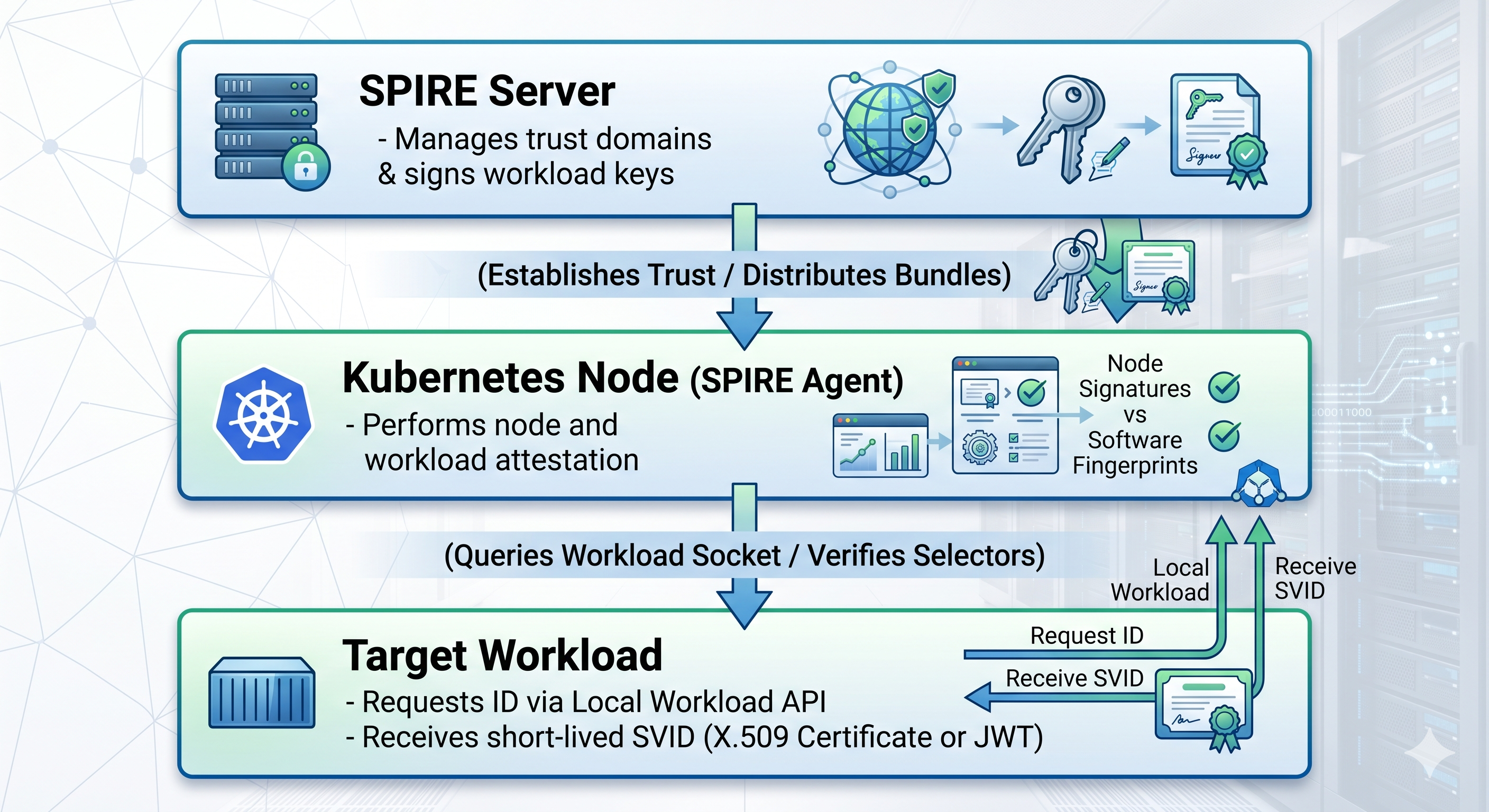
SPIRE implements these standards through a dynamic, highly automated attestation process :
First, the SPIRE Server establishes trust with the SPIRE Agent running on a specific node, verifying its platform characteristics (such as cloud instance metadata or TPM states) during node attestation. Once the node's legitimacy is confirmed, the SPIRE Agent exposes a local SPIFFE Workload API via a secure Unix Domain Socket.
Second, when a target workload launches, it queries this local socket to request its identity. This mechanism is highly secure because the workload does not need to possess any pre-shared bootstrap secrets, passwords, or configuration files.
Third, the SPIRE Agent intercepts this request and conducts workload attestation, querying the host operating system or the local Kubernetes API to inspect the caller's specific attributes. These attributes, known as selectors, include parameters such as the Kubernetes namespace, service account name, container image hash, or binary path.
Finally, if these selectors align with the registered security policies, the SPIRE Agent generates and issues a SPIFFE Verifiable Identity Document (SVID), typically formatted as a short-lived X.509 certificate or a JSON Web Token (JWT).
Workloads use these SVIDs to establish mutual Transport Layer Security (mTLS) sessions, authenticating one another cryptographically without ever relying on static, vulnerable database credentials or network location. This dynamic rotation of short-lived credentials drastically reduces the risk of credential theft and ensures that compromised components cannot be used to move laterally across the microservice mesh.
Retiring the Corporate VPN: Engineering a ZTNA Migration
Traditional Virtual Private Networks (VPNs) present fundamental structural weaknesses in modern security architectures. Legacy VPNs operate at the network layer, granting users broad, direct access to entire network segments once initial authentication is complete. This wide perimeter access allows threat actors who compromise a single remote endpoint or user credential to move laterally across internal networks with virtually no resistance.
Additionally, internet-facing VPN concentrators serve as high-profile targets for automated ransomware attacks, while the requirement to backhaul all traffic through a centralized data center degrades performance and encourages users to bypass security measures entirely.
Zero Trust Network Access (ZTNA) resolves these weaknesses by replacing broad network tunnels with application-specific, per-session micro-tunnels. ZTNA operates on a dark-net paradigm, concealing internal applications and servers from public network scans and exposing them only after rigorous identity and device context verification.
Architectural Migration Framework: From Tunneling to Policy Enforcement
When planning a migration from legacy VPNs to modern, identity-aware architectures, security leaders must evaluate several alternative deployment patterns:
| Architecture Pattern | Access Scope | Policy Enforcement Point (PEP) | Key Operational Trade-offs |
|---|---|---|---|
| Legacy Virtual Private Network (VPN) | Broad network-segment access. | External-facing VPN concentrator. | Simple to deploy, but creates a massive attack surface and permits unchecked lateral movement. |
| Gateway-Based ZTNA | Granular, application-specific access. | Dedicated gateways positioned at the network edge or data center boundary. | Highly secure; keeps internal resources hidden from public scans, but requires maintaining local gateway infrastructure. |
| Cloud-Native / SASE ZTNA | App-scoped access with inline inspection. | Distributed, cloud-managed edge proxy (Secure Access Service Edge). | Highly scalable; offloads patch management to cloud vendors and optimizes global performance, but creates reliance on third-party cloud infrastructure. |
| Network Microsegmentation | Tightly scoped service-to-service access. | Software-defined firewalls and host-based agents. | Effectively stops lateral movement, but requires high operational effort to map and configure rules. |
Execution of a Phased ZTNA Migration Pathway
A sudden, comprehensive transition from legacy VPNs to ZTNA is highly disruptive and prone to operational failure. A secure, risk-mitigated migration should follow a structured, phased roadmap:
- Phase 1: Traffic Baseline and Access Mapping: Leveraging the network dependency maps established in the Discovery Phase, security architects must document all remote access flows. Group applications by sensitivity, and begin the transition by replacing standard IP-based 5-tuple Access Control Lists (ACLs) with logical identity groups in the central directory.
- Phase 2: Hybrid Access Pilot: Deploy the ZTNA platform alongside the existing VPN infrastructure. Select a low-risk, internal web-based application and transition a small, technically proficient pilot user group to ZTNA. This phase is used to optimize connector placement, validate directory integrations, and ensure that identity-aware routing does not introduce performance latency
- Phase 3: High-Risk Access Isolation: Migrate high-risk access vectors, such as third-party contractor and vendor pathways, off the VPN and onto ZTNA. Shifting external partners to app-scoped ZTNA policies yields an immediate reduction in the corporate attack surface. Additionally, transition internal administrative connections (such as SSH and RDP paths) to secure, identity-aware jump hosts rather than allowing direct, unmonitored connections to internal infrastructure.
- Phase 4: Global Rollout and VPN Decommissioning: Deploy lightweight ZTNA clients to managed corporate endpoints while leveraging browser-based, clientless ZTNA options for unmanaged and BYOD environments. Once traffic monitoring confirms that all application access has migrated to the ZTNA control plane, decommission the legacy VPN concentrators. Finally, perform external network audits to verify that no public-facing network ports remain open to the internet.
Mitigating Legacy System Dependencies and Adoption Obstacles
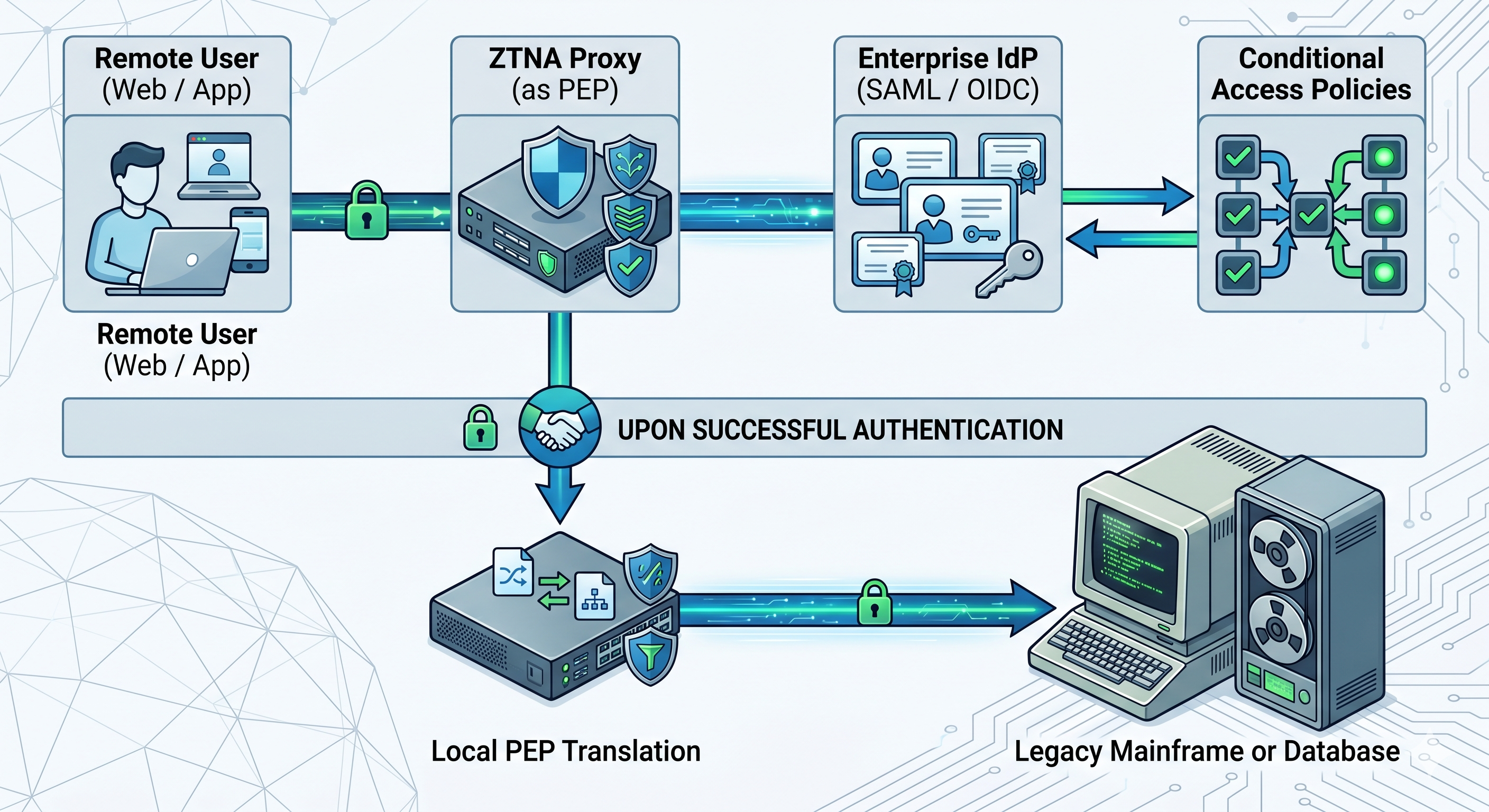
A common challenge during a ZTNA migration is accommodating legacy or on-premises systems that do not natively support modern identity federation protocols like SAML or OpenID Connect (OIDC). Security architects can bridge this integration gap by deploying identity proxy services or secure application gateways directly in front of these legacy systems. The ZTNA proxy intercept requests, forces authentication against the modern identity provider (IdP) to enforce Multi-Factor Authentication (MFA), and, upon validation, securely translates the user's authenticated context into the local headers or service accounts required by the backend system.
Beyond technical integration, change management represents a critical success factor. If remote users perceive the ZTNA transition as a cumbersome security restriction, internal resistance will stall adoption. The rollout must be structured and messaged as a productivity upgrade. User education must highlight the benefits of the new platform, showing that ZTNA eliminates the need to manually initiate connection clients, resolves connection drops, and delivers faster, direct routing to cloud-based applications.
Dynamic Risk Engines and Continuous Policy Enforcement
A passive, static access policy is insufficient to counter modern threat vectors that exploit legitimate but compromised credentials. To defend against credential misuse, advanced ZTA deployments employ a dynamic risk engine to continuously evaluate and score risk.To formalise this capability, the Policy Decision Point (PDP) evaluates incoming access requests and active sessions using a multi-weighted dynamic risk algorithm:$$\text{Risk Score} = w_1 \cdot I_{\text{assurance}} + w_2 \cdot D_{\text{posture}} + w_3 \cdot C_{\text{signals}} + w_4 \cdot B_{\text{behaviour}}$$
Where:
- $I_{\text{assurance}}$ represents the strength and cryptographic validity of the identity verification process, ranging from weak passwords to phishing-resistant FIDO2 passkeys.
- $D_{\text{posture}}$ measures the health and security compliance of the requesting device, incorporating parameters such as operating system patch levels, disk encryption states, and active EDR telemetry.
- $C_{\text{signals}}$ evaluates context-based environmental metadata, including physical location, access time, and network routing vectors.
- $B_{\text{behaviour}}$ evaluates the anomaly score calculated by User and Entity Behavior Analytics (UEBA), flagging unusual user activity patterns, impossible travel scenarios, or anomalous data access volumes.
- $w_1, w_2, w_3, w_4$ represent dynamic coefficients adjusted programmatically based on the sensitivity classification of the target resource.
This dynamic risk score is calculated continuously, allowing the Policy Decision Point to trigger real-time, automated policy responses based on changing environmental context :
-
Adaptive MFA Step-Up: If a validated user attempts to access a highly sensitive financial repository or code database from an unusual location, the system prompts for a FIDO2 biometric passkey check mid-session, validating the identity without terminating the connection.
-
Automated Quarantine: If an active device is flagged by the EDR agent for hosting a suspicious background process, the dynamic risk engine adjusts the posture score ($D_{\text{posture}}$) instantly, prompting the PDP to command the PEP to terminate the active session and isolate the device on the network.
-
Session Lifetime Reduction: For high-privilege administrative actions, session lifetimes are dramatically shortened. If behavior patterns deviate from standard baselines, the risk engine triggers a forced re-authentication challenge to prevent credential harvesting.
Strategic Synthesis
Transitioning to a Zero Trust Architecture is an iterative journey of continuous operational improvement, not a simple vendor tool acquisition. Successful implementations depend on a structured execution of key security strategies:Prioritise the discovery phase to construct an authoritative, real-time map of users, devices, application dependencies, and data locations before enforcing access rules.Replace traditional network-level controls and 5-tuple ACLs with cryptographic, platform-agnostic workload identity standards like SPIFFE/SPIRE to secure service-to-service and AI-driven interactions.Decommission vulnerable legacy VPN architectures using a phased, risk-mitigated migration pathway, reducing immediate exposure by prioritizing external third-party access first.Minimize adoption friction by framing the ZTNA rollout as a user productivity upgrade, supported by clear user education on performance improvements.Transition from static security policies to a dynamic control plane driven by a real-time risk scoring engine, enabling automated containment and adaptive step-up authentication.By systematically aligning these technical capabilities, security teams can build a highly resilient architecture capable of protecting critical business assets, mitigating lateral movement, and adapting to modern, complex threat landscapes.